Buy the right size, pick a pleated filter your system can breathe through, write the change date on the frame, and replace it on schedule. That is most of furnace filter advice, and the rest is detail.
The detail matters because a filter that is too restrictive or left in too long makes the blower work harder, and a clogged filter is a common, avoidable cause of weak airflow. DOE says to clean or replace furnace filters once a month or as recommended, and ENERGY STAR says to inspect, clean or change them once a month for central air, furnace and heat pump systems. [1] [2]
This is the buyer’s guide: sizes, types, schedule, and annual cost. It deliberately skips the full explanation of the MERV scale, which has its own page. Here you only need to know the rule of thumb and the one mistake to avoid, which is buying the highest number on the shelf without checking whether your equipment can handle it.
- Match the size printed on your current filter, check the depth, and install the arrow toward the blower.
- A pleated filter at MERV 6 or higher is a reasonable floor (Building America guidance cites it as an ENERGY STAR requirement), and EPA’s MERV 13 recommendation comes with the condition that your system can handle it. [3] [4]
- Check the filter every month and replace it when it is clogged. [2]
- Work out annual cost as filters per year times price per filter, and compare options per month of service.
Step 1: Find the right size
The correct filter fits the slot with no gaps around the edges. Air takes the easiest path, so a filter that is even slightly undersized lets unfiltered air slip past and loads dust onto the blower and coil.
Look at the edge of the filter you already have. Printed there are two sets of numbers: a nominal size (the rounded name, written as length by width by depth in inches) and often an actual size that is a little smaller. Buy by the size printed on your current filter. If the old one has no printing, measure the slot itself, in inches, for length, width and depth, and match to the nearest standard nominal size.
- Check the depth. Filters come in one inch and thicker versions. A thicker filter only fits if the cabinet was built for it, so do not squeeze one into a one inch slot.
- Check the airflow arrow. The arrow printed on the frame points toward the blower, in the direction air flows. Installing it backward cuts performance.
- Check for more than one filter. Some homes have a filter at the furnace and one or more at return grilles. Look at every return before you stock up.
Step 2: Choose the type, not the highest number
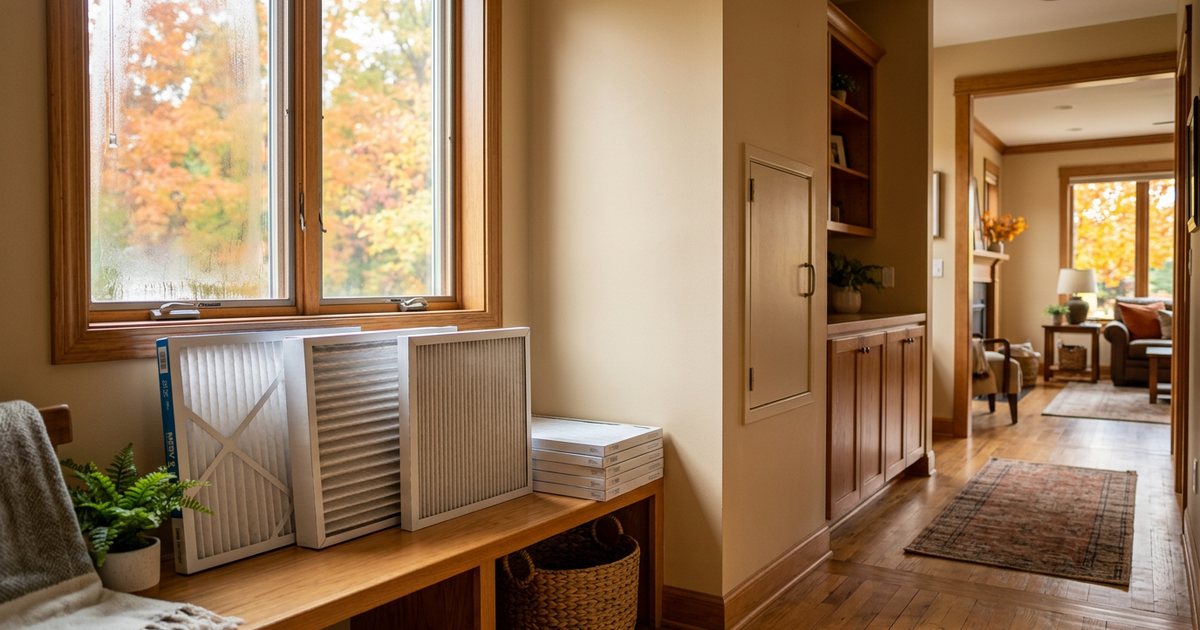
Most homeowners are choosing between three kinds of filter. The names matter less than how well each one captures particles and how much it resists airflow.
Fiberglass panel filters are thin, cheap and mainly protect the equipment from large debris. They do little for the air in your home. Pleated filters use folded media with far more surface area, capture finer particles, and are the sensible default for most systems. Washable and electrostatic filters can be reused, but they need real cleaning on a regular schedule, and a dirty one restricts airflow like any clogged filter.
Within pleated filters you will see a MERV number, which rates how well the filter captures particles between 0.3 and 10 microns. [4] The scale itself is covered separately, but two facts guide a purchase. Building America guidance notes that ENERGY STAR requires filters of MERV 6 or higher, which makes it a reasonable floor if you want a filter that does something. [3] And EPA recommends upgrading to at least a MERV 13 rating, or as high as your system fan and filter slot can accommodate. [4]
The second half of that sentence is the one people skip.
Step 3: Check that your system can handle it
A higher MERV filter restricts airflow more, and building science guidance is blunt about it: higher MERV filters restrict airflow. [3] A system with a weak blower or undersized return can end up with less air than it was designed for, which means longer run times, poorer heating, and, in a furnace, a greater chance of overheating and shutting off.
A technician can measure the answer by checking static pressure after a filter change; the MERV explainer covers the target figure. If you cannot get that measured, use symptoms as a signal. Warning signs after a filter upgrade include weak flow at the registers, a furnace that runs longer than before, whistling at the return, and a filter that sucks flat against the grille.
If you see those signs, step down one MERV level or switch to a deeper media filter in a cabinet designed for it, and ask a licensed HVAC contractor to evaluate the duct and blower. Do not open the furnace cabinet or touch gas components yourself.
Step 4: Set a change schedule
The right interval is the one your filter and house require, not a calendar rule. DOE and ENERGY STAR both point to checking monthly. [1] [2] Check it every month, and replace it when it looks gray and the pleats are packed. Building science guidance adds that filters should be replaced immediately if they are clogged with debris. [3]
ENERGY STAR notes that airflow problems can reduce your system’s efficiency by up to 15 percent. [2] The source does not say how much of that loss comes from dirty filters, so read it as a reminder of what is at stake, not a prediction.
- Homes with pets, shedding fur, smokers, or heavy dust usually need changes sooner.
- Construction or renovation dust can clog a new filter in days, so check it often during projects.
- Heating and cooling seasons are the heavy-use periods. In a shoulder season with little runtime, a filter lasts longer.
- Write the install date on the frame in marker, and set a recurring phone reminder.
What filters cost per year
Prices vary by brand, size and retailer, so work it out with your own numbers. The formula is simple: filters per year multiplied by the price per filter, plus a small allowance for the occasional extra change.
For example, if you change a one inch pleated filter every month, the annual cost is twelve filters’ worth. [2] If instead you buy a thicker media filter that lasts longer between changes, and need only two a year, the annual cost is two filters’ worth. Compare the two on cost per month of service, not price per filter.
Buying in multipacks lowers the unit price and removes the excuse to skip a change. Do not stretch intervals to save money: a clogged filter makes the blower run harder, and the lost efficiency may cost more than a new filter does.

Common mistakes
None of these needs a professional to fix. Anything involving the furnace cabinet, burners, venting or gas connections does, and so does persistent airflow trouble after you have fixed the filter.
- Buying the highest MERV without checking static pressure or airflow.
- Installing the filter backward, against the airflow arrow.
- Leaving gaps around the filter because it is a size too small.
- Treating a washable filter as maintenance-free.
- Forgetting the filter at the return grille when the furnace has one at the cabinet.
FAQ
How often should I change my furnace filter?
DOE says to clean or replace furnace filters once a month or as recommended, and ENERGY STAR says to inspect them monthly. [1] [2] Replace sooner if the filter is clogged.
What MERV rating should I buy?
Building America guidance says ENERGY STAR requires filters of MERV 6 or higher, and EPA recommends at least MERV 13 or as high as your fan and filter slot can accommodate. [3] [4] If you are unsure what your system can handle, ask an HVAC contractor.
Can a filter that is too restrictive damage my furnace?
Higher MERV filters restrict airflow. [3] Weak airflow can cause poor heating and longer run times, so step down a level if you notice it and have a contractor check the system.
Does a dirty filter raise my energy bill?
It can. ENERGY STAR says airflow problems can reduce a system’s efficiency by up to 15 percent. [2] The filter is only one cause, but it is the cheapest one to fix.
Turn off the furnace before you open the filter compartment, and do not remove panels, touch burners, or work on venting or gas connections: call a licensed HVAC professional for those. Install CO alarms near sleeping areas, and never block combustion air or return openings.
Sources
- Tips on Saving Money and Energy in Your Home (Energy Saver Guide, 2022). U.S. Department of Energy, accessed 2026-10-12
- Maintenance Checklist | ENERGY STAR. U.S. EPA ENERGY STAR, accessed 2026-10-12
- High-MERV Filters | Building America Solution Center. PNNL / U.S. DOE Building America Solution Center, accessed 2026-10-12
- What is a MERV rating? | US EPA. U.S. EPA, accessed 2026-10-12
Savings, costs and rebate figures are estimates from the dated sources cited on each page; your results depend on your home, climate and utility rates, and incentive programs change often. Gas, venting and electrical work belongs with a licensed professional. This is general information, not financial, tax or legal advice. As an Amazon Associate we earn from qualifying purchases.
