Tankless usually beats a storage tank on energy use, and a tank usually beats tankless on upfront cost. Which one saves you money depends mostly on one number: how much hot water your household uses each day. Low-use homes gain the most from tankless. Heavy-use homes gain little.
This is a decision guide, not a product tour. Below you will find the published efficiency gaps, how fuel prices change what those percentages are worth, the cases where a tank is the better buy, and a short checklist you can run in ten minutes.
- DOE says tankless is 24%-34% more efficient than a tank for low-use homes and 8%-14% for high-use homes. [1]
- ENERGY STAR estimates certified gas tankless saves a family of four $95 per year versus a standard gas tank. [2]
- A tank wins on upfront cost, easy retrofit and no flow limit; tankless wins on standby loss and a 20-year life.
- In an all-electric home, compare a heat pump water heater before choosing electric tankless.
- Divide your real price gap by your real yearly saving; if payback outlasts the unit, buy the tank.
The efficiency gap, and why usage decides it
A storage tank keeps a large volume of water hot all day and all night, and it loses some heat through the tank walls even when nobody is home. A tankless unit avoids that standby loss by heating only on demand.
DOE puts numbers on it. For homes that use 41 gallons or less of hot water daily, on-demand water heaters can be 24%-34% more energy efficient than conventional storage tank water heaters. For homes that use a lot of hot water, around 86 gallons per day, they can be 8%-14% more efficient. [1]
The gap narrows as use climbs because, in a busy household, the water spends less time idling in the tank. More of the energy goes into actually heating water, and both designs have to do that.
What that means in dollars
ENERGY STAR estimates that certified gas tankless units save a family of four $95 per year, or $1,800 over their lifetime, compared with a standard gas storage model. [2] That is a modest annual figure, which is why a higher purchase price can take many years to recover.
Percentages also translate differently depending on fuel price, and prices swing by season. EIA’s table of average U.S. residential natural gas prices shows 26.45 dollars per thousand cubic feet in July 2026 and 14.95 in February 2026. [3] A percentage saving on a gas bill is worth more when the price per unit is higher, so your own bills matter more than a national average.
On the electric side, a 2012 DOE Building America report said that, at best, an electric tankless water heater could save about 12% in energy costs over an electric tank-type unit. [4] That is a best case from an older report, and it is small, which is one reason heat pump models are a better electric upgrade.
Where a tank wins
A storage tank has no flow limit in the short term. It holds a reserve, so it can run several fixtures at once until that reserve runs low. A tankless unit has a fixed flow rating at a given temperature rise, and DOE says you may find you need two or more tankless water heaters to keep up with demand. [1]
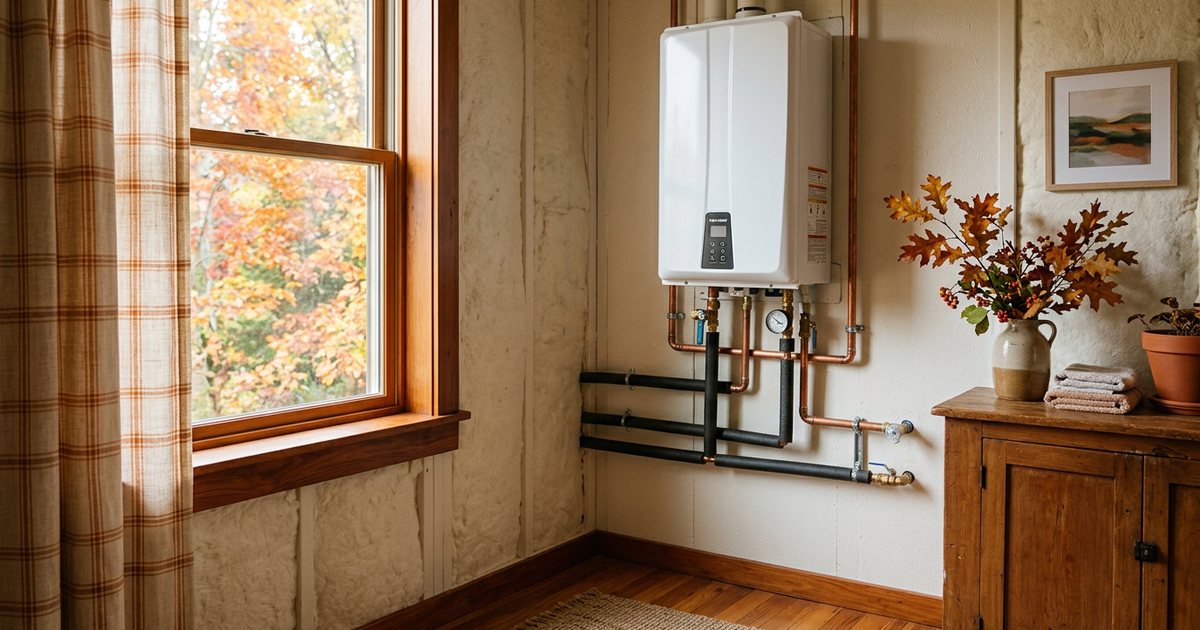
A tank is also easier to retrofit.
It usually uses the existing gas line, vent and electrical connection, while a tankless swap can need a larger gas line, new venting, or a bigger electrical circuit. The 2012 DOE report notes that most electric tankless units require 50-200 amps. [4]
Finally, upfront cost. ENERGY STAR’s comparison lists initial cost (heater plus installation) at $800-$2,000 for gas tankless and $450-$1,200 for an electric tank. [5] Those ranges overlap, and a tankless install that needs a bigger gas line or new venting will sit toward the top of its range or above it.
Where tankless wins
Tankless earns its premium in a few specific situations: a gas home with modest hot water use, a place where the old tank’s footprint matters, and a household that wants to stop running out of hot water after a long shower. It also lasts longer. DOE says most storage water heaters last 10-15 years while tankless units can last more than 20 years. [1]
ENERGY STAR gives the same 20-year life expectancy for tankless units. [2] If a tank would need replacing once during that span, the avoided second purchase improves tankless’s math.
A ten-minute decision rule
Answer these questions in order and stop at the first clear result.
- Is your home electric with space for it? Look at a heat pump water heater first. DOE says heat pump water heaters can be two to three times more energy efficient than conventional electric water heaters, a much bigger gain than electric tankless offers. [1]
- Is your household large, with several showers and laundry running together? A tank (or two tankless units, priced honestly) is usually the safer buy.
- Is your gas line and vent already suitable, and does your household use little hot water? Tankless is worth a quote.
- Does a quote show a payback far beyond the unit’s life? Choose the tank and spend the difference on lowering the temperature setting and insulating hot water pipes. DOE says pipe insulation can save an additional 3%-4% per year on water heating. [1]
Find your own numbers before you decide
National averages only get you so far. Your own utility bills tell you more, and you can pull them out in a few minutes. Look at your gas or electric bill in a summer month when heating and cooling are off. The baseline use in that month is mostly water heating, cooking and drying, which gives you a rough ceiling on what a more efficient heater could ever save.
Next, count your hot water events on a typical day: showers, dishwasher cycles, laundry loads. A household that runs one or two of these at a time, spread across the day, is a better tankless candidate than one that stacks them together every evening. The stacking is what forces you into a bigger unit or two units, which erodes the savings.
Then ask for two like-for-like written quotes, one for a tank and one for tankless, each with the full install scope itemized. Subtract the tank quote from the tankless quote, and divide that gap by the yearly saving you think is realistic. If the answer is longer than you plan to stay in the house, or longer than the tank would last, the tank is the better financial choice even though tankless is the more efficient machine.
Efficiency and savings are not the same thing.
Standards are changing the tank side too
DOE’s April 2024 announcement of its final water heater efficiency rule said compliance would be required starting in 2029, and it expects over 50% of newly manufactured electric storage water heaters to use heat pump technology, compared with 3% today. [6] Gas tankless standards were not part of that final rule, since DOE is still considering amended standards for gas-fired instantaneous water heaters. [6]
The practical takeaway: if you are replacing an electric tank, the market is already moving toward heat pump designs. If you are replacing a gas tank, the tankless-or-tank question is still a straight cost-versus-use decision as described above.
For a gas tank replacement, ENERGY STAR sets a minimum first hour rating of 51 gallons per hour for certified gas storage models. [7] Ask what first hour rating a tank must have for your household, since an undersized tank leaves you cold in the shower.

FAQ
Is tankless cheaper to run than a tank?
Usually, yes, though by how much depends on your usage. DOE cites 24%-34% better efficiency in low-use homes and 8%-14% in high-use homes. [1]
Which lasts longer, tankless or tank?
DOE says most storage tanks last 10-15 years while tankless units can last more than 20 years. [1]
Does tankless give unlimited hot water?
No. It gives continuous hot water up to its rated flow at your temperature rise. DOE notes you may need two or more units to keep up with simultaneous demand. [1]
Is electric tankless better than an electric tank?
Only slightly. A 2012 DOE report said at best about 12% in energy cost savings. [4] A heat pump water heater is the larger efficiency step for an electric home.
Can I switch from a tank to tankless myself?
Not safely for gas units. Gas piping and venting are licensed-professional work, and electric tankless units require an electrician to size the circuit.
A change from tank to tankless can alter gas demand, venting and electrical load. Have a licensed plumber or electrician confirm gas line size, venting and panel capacity before you buy, and keep carbon monoxide alarms working on every level.
Sources
- Tips on Saving Money and Energy in Your Home (Energy Saver Guide, 2022). U.S. Department of Energy, accessed 2026-10-12
- Save More with ENERGY STAR Gas Tankless Water Heaters | ENERGY STAR. U.S. EPA ENERGY STAR, accessed 2026-10-12
- Average Residential Price, Natural Gas Prices | EIA. U.S. Energy Information Administration, accessed 2026-10-12
- Measure Guideline: Transitioning to a Tankless Water Heater (Building America, Sept 2012). U.S. DOE Building America (IBACOS), accessed 2026-10-12
- Is a Heat Pump Water Heater Right for Your Home? | ENERGY STAR. U.S. EPA ENERGY STAR, accessed 2026-10-12
- DOE Finalizes Efficiency Standards for Water Heaters (2024-04-30). U.S. Department of Energy, accessed 2026-10-12
- Water Heater Key Product Criteria | ENERGY STAR. U.S. EPA ENERGY STAR, accessed 2026-10-12
Savings, costs and rebate figures are estimates from the dated sources cited on each page; your results depend on your home, climate and utility rates, and incentive programs change often. Gas, venting and electrical work belongs with a licensed professional. This is general information, not financial, tax or legal advice. As an Amazon Associate we earn from qualifying purchases.