Duct sealing cost depends mostly on which method you pick. Doing it yourself with mastic and mesh tape costs the price of materials and a weekend. In the published figures below, manual contractor sealing is priced lower than aerosol sealing. HomeGuide, a cost-data publisher, reports that air duct sealing costs $1 to $2 per square foot or $1,000 to $6,000 total, and that sealing with the Aeroseal brand costs $1,500 to $6,900 on average. [1]
Those are contractor-estimate ranges, not guarantees, and the spread is wide. This guide shows what drives the price, how DIY and the two professional methods compare, how to read a quote, and how to decide whether the money is likely to come back.
- Published contractor ranges run $1 to $2 per square foot or $1,000 to $6,000 total, with Aeroseal-brand sealing averaging $1,500 to $6,900. [1]
- One contractor blog puts classic manual sealing at $1,000 to $1,500 for a typical home. [2]
- Aerosol sealing cannot reach return leaks or register junctions, so ask who hand seals those. [3]
- Insist on a before-and-after leakage test, whichever method you choose.
What published price ranges actually say
Two published sources give a useful picture. HomeGuide reports $1 to $2 per square foot or $1,000 to $6,000 total for duct sealing in general, and $1,500 to $6,900 on average for Aeroseal-brand sealing. [1] A separate HVAC contractor blog, GS Home Services, says classic manual sealing costs between $1,000 and $1,500 for a typical home when contractors use mastic, foil tape and spot repairs, with per-area pricing roughly $1 to $1.50 per square foot as a general rule. [2]
Read those as marketplace and contractor figures. A contractor’s blog has an obvious interest in the work, and a marketplace averages jobs across very different houses. Your own quote will move with the number of accessible joints, how many ducts are in tight crawl spaces, and local labor rates. Get at least two written quotes that say which method will be used and what leakage test will be run.
DIY: the cheapest route for accessible ducts
If your ducts run through an open attic, basement or crawl space, hand sealing is within reach of a careful homeowner. The material list is short: mastic paste, fiberglass mesh tape, a brush or gloved hands, a rag, and for larger holes some sheet metal and screws. The Department of Energy’s weatherization job aid describes small, medium and large gap methods, all built on mastic. [4]
Material cost is modest next to a contractor visit, though this guide does not put a dollar figure on it. Check current shelf prices for a few tubes or buckets before you commit.
The real cost of DIY is your time and the accuracy of your work. Mastic that misses a joint saves nothing. The cost is also uncertain at the end, because without a leakage test you cannot say how much improved.
DOE says all duct sealing should be tested by a qualified professional to ensure combustion safety and proper air flow, so budget for that check even if you do the sealing. [5]
Hiring out: manual sealing versus aerosol sealing
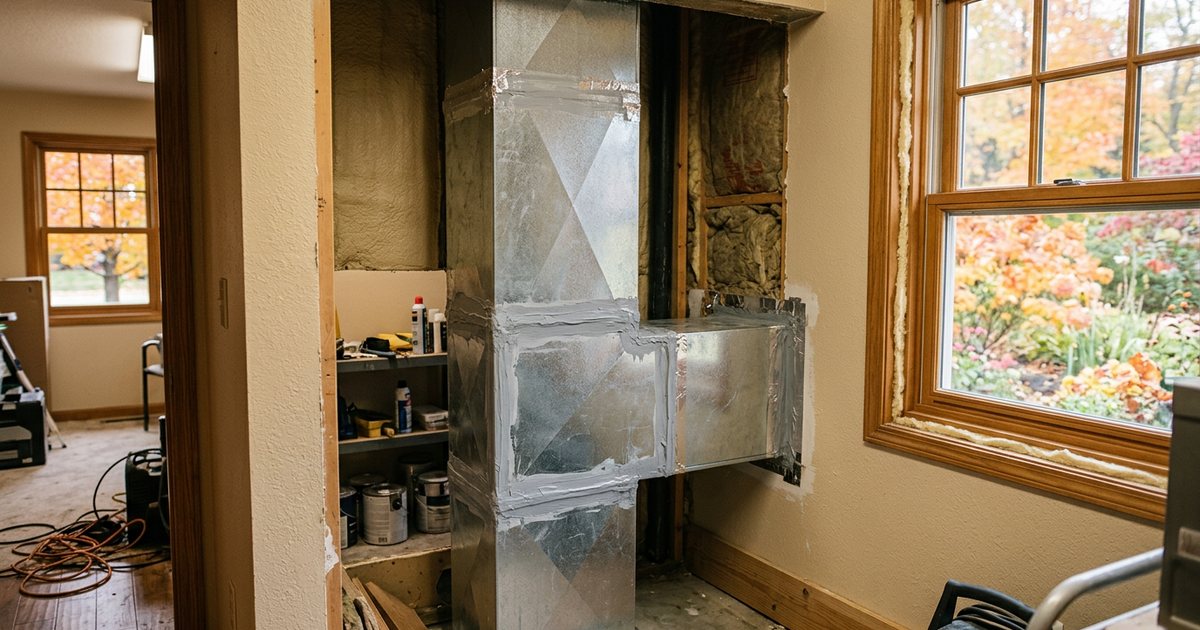
Manual contractor sealing uses the same kinds of materials as DIY and can reach places you cannot. It sits at the low end of the price ranges above. Aerosol sealing is priced higher in the figures above, and a building science guide notes that most local codes require a licensed HVAC contractor for this work. [3]
Aerosol sealing is not simply a premium version of hand sealing. It cannot seal leaks in the return, at the air handler, or at the junction between registers and finish surfaces, and gaps larger than 5/8 in. are recommended to be sealed manually with mesh tape and mastic. [3] Ask any aerosol bidder who will hand seal the parts the spray misses, and whether that is in the price.
The same guide says injected spray is less suitable for sealing systems to less than 40 to 60 CFM of leakage. [3] In practice that means a house whose ducts are already fairly tight may not need the more expensive process at all.
Will the money come back?
ENERGY STAR says duct sealing can often pay for itself in energy savings. [6] It also says leaky ducts can reduce heating and cooling system efficiency by as much as 20 percent. [6] Those are ceilings and generalities, not a guarantee for your house.
DOE’s Building America air sealing report cites one New York apartment duct-sealing retrofit with a simple payback of 3 to 4 years. [7] That is a single project, so treat it as an example of what a good result can look like, not a promise.
For example, if a quote lands near the high end of the ranges above and your heating and cooling costs are high in a house with ducts in a hot attic, the payback is likely to be quicker than the same quote in a house with short ducts inside the conditioned space. Take your own annual heating and cooling spending, apply a conservative savings guess, and divide the quote by the result. If that number is longer than you plan to stay in the house, skip aerosol and do the accessible parts by hand.
Cheaper steps to take before you spend big
Duct sealing is rarely the first dollar to spend, and it is rarely all-or-nothing. If you want to keep costs down, work in this order. First, look at the ducts yourself, because accessible leaks at the furnace, plenum and boots are a sensible place to start, and they are the cheapest to fix by hand.
Second, call your electric or gas utility and ask about duct sealing or weatherization rebates before you sign anything.
Programs differ by state and utility, and some require the work to be done by a participating contractor, which can change the price you pay. Households that qualify by income can also ask about the Weatherization Assistance Program, which can include duct sealing as part of a whole-house package.
Third, if you hire out, ask for the cheapest method that fits your ducts. A house with straightforward, reachable ducts may not need aerosol sealing at all, while a house with ducts buried in finished chases may not be fixable any other way. Paying for aerosol on ducts that a technician could reach by hand can be a way to overspend.
How to read a duct sealing quote
A trustworthy quote names the method, the areas covered, and the test. Look for these items:
- A before-and-after leakage test, with the target stated. A building science checklist gives a target of preferably 10% or less of total air flow. [8]
- Materials named: UL-approved mastic, UL 181 tape or an equivalent such as aerosol sealant. [8]
- A statement of what is not covered, such as ducts in finished walls or the return plenum.
- A combustion safety check if you have gas or oil appliances.
- Whether insulation removal and replacement in the attic is included.
FAQ
How much does duct sealing cost?
HomeGuide reports $1 to $2 per square foot or $1,000 to $6,000 total, and a contractor blog puts classic manual sealing at $1,000 to $1,500 for a typical home. [1] [2]
Is Aeroseal worth the extra cost?
It can be when ducts are leaky and hard to reach, but it does not seal return, air handler or register-boot leaks, and it is less suitable below 40 to 60 CFM of leakage. [3]
Is DIY duct sealing really cheaper?
Usually, for accessible ducts, because the main cost is materials and your time. The tradeoff is that you will not know the result without a leakage test, which DOE advises a qualified professional to run. [5]
Can a rebate help?
Utility rebates, state programs and the income-qualified Weatherization Assistance Program may cover duct work. The federal Energy Efficient Home Improvement Credit ended for property placed in service after December 31, 2025, so do not plan around it. [9]
Duct sealing changes house pressures, so have gas and oil appliance venting checked by a qualified professional after the work, and keep carbon monoxide alarms working. Cost figures here are published estimates from third parties; get local written quotes.
Sources
- How Much Does Air Duct Sealing Cost? (2026). HomeGuide (cost-data publisher; contractor estimates), accessed 2026-10-12
- How Much Does Duct Sealing Cost? (2026). GS Home Services (HVAC contractor blog), accessed 2026-10-12
- Injected Spray Sealant for Existing HVAC Ducts (aerosol sealing). Building America Solution Center (PNNL, U.S. DOE), accessed 2026-10-12
- Job Aid 19-1: Seal Ducts With Mastic (Weatherization Assistance Program). U.S. Department of Energy / NREL (Weatherization job aid), accessed 2026-10-12
- Tips on Saving Money and Energy in Your Home (Energy Saver Guide 2022). U.S. Department of Energy (Energy Saver), accessed 2026-10-12
- Benefits of Duct Sealing. ENERGY STAR (U.S. EPA/DOE), accessed 2026-10-12
- Retrofit Techniques and Technologies: Air Sealing (Building America Best Practices Series Vol. 10). U.S. Department of Energy (EERE Building America), accessed 2026-10-12
- Duct Sealing and Insulation (Home Improvement Expert checklist). Building America Solution Center (PNNL, U.S. DOE), accessed 2026-10-12
- FAQs for modification of sections 25C, 25D, 25E, 30C, 30D, 45L, 45W and 179D under Public Law 119-21 (OBBB), FS-2025-05. Internal Revenue Service, accessed 2026-10-12
Savings, costs and rebate figures are estimates from the dated sources cited on each page; your results depend on your home, climate and utility rates, and incentive programs change often. Gas, venting and electrical work belongs with a licensed professional. This is general information, not financial, tax or legal advice. As an Amazon Associate we earn from qualifying purchases.
